RADIOACTIVE DREAMS: Let’s start talking a little about how did you started your movie career and the experience of working with legendary director Akira Kurosawa.
ALBERT PYUN: I was brought to Japan when I was 18 by Japanese superstar Toshiro Mifune, he saw a short film I had done. My experience was limited with Kurosawa because I couldn't speak or read Japanese and the project, Dersu Uzala, was going to star Mr. Mifune. I was a bit lost initially. Some would say I still am!
When Mr. Mifune decided not to do it, I went to work at his Mifune Productions, becoming assistant cameraman to the great Takao Saito, who was the DP on a number of Kurosawa's films. He was, with Mr. Mifune, my principal mentors. Neither spoe English but they were very patient and open in helping me understand what we were shooting and why.
What are your major influences?
I think growing up the films of Kubrick, Bergman and Truffaut, Lindsay Anderson were big influences along with the theatrical stylizations of Leone and some of the more experimental filmmakers like Jordan Belson and Stan Breckenridge. I enjoyed Dennis Hopper's film a lot as well as Hal Ashby, Robert Altman's early films, Nicholas Roeg, Ken Russell and Richard Lester. But Kubrick, Leone and Saito taught me the importance and the art of the frame. Composition, color, balance. How they are as important as dialogue, music and editing. I really love telling story and revealing character thru the frame.
Your favorite movies and directors?
When I was really young A Fistful of Dollars, 400 Blows and Dr. No made huge impacts. Later 2001: A Space Oydssey, O' Lucky Man, Brewster McCloud, The Long Goodbye, The Three Musketeers by Richard Lester. And weirdly, Jesus Christ Superstar was a big favorite of mine. I've seen it more than 50 times I think. Maybe some of the King Fu films of the time. The King Hu films. William Friedkin's Sorcerer and Pakula's Parallax View. I loved how those films end their journey. I find myself drawn to scripts with that sort of ending. Tragic, doomed and bittersweet. Loved all the John Cassevetes films like Faces, Killing of a Chinese Bookie and Minnie and Moskowitz. LOVED the Tempest.
Your first movie is a fantasy adventure called The Sword and The Sorcerer. Why start with a movie that depends of a certain degree of resources? What where the main challenges?
Back then, movies had to have a theatrical life, so the thinking was different than today. You had to make something for a wide audience and you really didn't think as much about budget. You made what you wanted to make. At least that was my thinking. Who knows, maybe I was too naïve.
In the cast of The Sword and The Sorcerer, we have a character actor that many B-fans are in love: Richard Lynch. How was working with him?
Well, for my first experience as a director, Richard was a handful! A delight but sometimes scary because of his intensity and commitment to each moment in a scene.
Your next movie was Radioactive Dreams, the first one with post-apocalipctic themes. It would be great to hear about your fascination about this universe.
I don't really know why I do. But I am drawn to the extreme human situation and the dynamic landscape visually. I think its like a stage where you can explore ideas freed from the conventions of a real world. Where everything can be designed and stylized around a central theme.
The noir genre have influences when you started writing the script for Radioactive Dreams? And Blade Runner?
The biggest influences were The Man who Fell to Earth, Walkabout and The long Goodbye.
Still on Radioactive Dreams, you started a long partnership that stay alive until today with a great music composer called Tony Riparetti. What is the secret of a so long partnership between musician and director?
I think we see things the same way. We respect each other's talent and we enjot collaborating. Tony is really a genius. I fear sometimes I've held him back because he could be working on larger films with bigger budgets.
How was to work with Menahem Golan of Cannon?
Fun. Crazy. And LOUD! He loves movies and the whole movie world and that was exciting and infectious. A good man. You got an idea, you went right to him and pitched it. His eyes would light up and he'd say “Go make it! I want to see that movie!”. He was great for a young crazy filmmaker like me. The only movie I regret not getting made there was a remake of Johnny Guitar with Mickey Rourke in the Sterling Hayden title role.
Cyborg is considered your best movie. What do you think about it?
I'm conflicted about it. The released version isn't the movie I made but I can see why people love it. I hope one day to get my operatic version of Cyborg out.
I read about your intention of shooting Cyborg like a opera, without dialogues and black & White. A pretty unusual idea, could you tell us a bit more?
There will be something coming out that I can't discuss yet. In April, in conjunction with the release off Tales, there is a Cyborg goodie coming with MGM's blessing. So let's talk after that goodie is released!
How did you find Vincent Klyn? It’s hard to imagine Cyborg without his unforgettable perfomance as Fender, one of the great villains from the 80’s action cinema.
I was casting Masters of the Universe 2 and went to Hawaii to meet with a big wave surfer named Laird Hamilton to replace Dolph. At the meeting with Laird, Vince somehow convinced him to let him tag along. I was impressed with both. When Masters got cancelled I remebered Vince.
In some moments of Cyborg, you bring several elements from the Spaghetti Westerns to compose the narrative. Do you have some influence of the subgenre on this sense?
Yeah, I wanted to bring that theatrical style and drama to the post apocalypse genre. Adding martial arts as well which hadn't really been done either. I thought martial arts and spaghetti stylization really lent themselves to a futuristic opera of violence.
How was working with Jean Claude Van Damme?
He was a great. I struggled with his accent which was still quite thick. That was difficult. He was still just getting comfortable with being a lead.
We entered in the 90’s with your adaptation of Captain America. How the project became to you?
It had been bouncing around and one day Menahem asked me to read. I told I loved the script and off we went. There was a clock running because Menahem's rights to Capt america were about to expire.
What were the main challenges and how was to deal it with such a icon character of US culture?
The first issue was lack of funding throughout. Menahem was never able to close his financing. And the second was the costume. The costume was tough to make work in any sort of real way.
Between your most famous movies, Captain América is considered one of your worses. What became so wrong and what is your opinion about it?
Well, my director's cut is much better than the released version – in my opinion. I left the picture when it was still in post. Clearly what went wrong was lack of funding and a budget. Hard to get around having no money on a comic book movie. It erodes the quality quickly.
What you think about the actual comic adaptatons? Do you like of some of them?
Yeah. My favorites are Blade and Tim Burton's Batman.
Dollman is one of your funniest movies. Talk a bit about it, about the challenge of doing a movie so dependant for tricks and special effects, since the main character have the size of a doll.
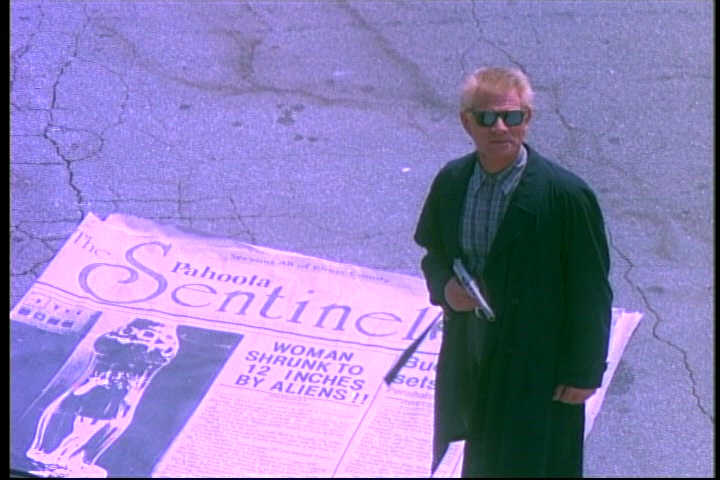
Well, the key is Tim Thomerson. Everything springs from him. I wanted to do a gritty urban film in a sort of verite' style with this odd tiny alien cop in the middle of it all. I thought that was an interesting way to make the budget work for us and I wanted to see if the juxaposition could work.
Besides Dollman, you also made Arcade, another movie produced by Charles Band. What do you think about this producer/director whose movies marked the B-cinema from 80’s and 90’s?
I like Charlie. He's a charming and creative guy. But we never saw eye to eye on the films. He's much more use to controling the movies and rightfully so. He wants them to adhere to his specific concept of brand and style. But I was never one to adhere to anything so we had some disagreements. I just like to make the movies my way.
Let’s talk about Nemesis, which features great action scenes and some striking visual compositions. How was working on this movie? A hell of a cast you bring to this, by the way.
It was great. Ash Shah, the producer, and I were like two kids creating wild meyhem. I left the film after the rough cut however. I was nudged out the door. I started on a CGI enhanced version of Nemesis in 1999. It was called Nemesis 2.0 but we never got beyond the first 15 minutes before the studio that owned the Nemesis name went bankrupt in Denmark. I will release this first 15 minutes for free on DVD as a bonus.
What do you think of Omega Doom and how was to work with Rutger Hauer, who you also directed on Blast?
Well, I wished we had a larger budget. The original script by Ed Naha and I took place in Euro Disney and the characters were the remaining animatronics left after all humans had perished. But we had to adjust to the budget. Rutger was challenging and envigorating to work with. So much skill and talent backed with keen intelligence. You really felt you had to be throughly prepared and at the top of your game when working with Rutger. Every beat was critical to him and thought through.
We read you mentioning Mean Guns as your favorite movie as director. What makes him so special?
For the simple reason it was released almost exactly the way I wanted it. That was and is so satisfying.
What do you think of Christopher Lambert and how is to work with him?
I think he's an underappreciated talent who has once in a generation charisma. I adored working with him and I hope his performances in my films rank as some of his better because we really tried, under a short schedule, to do good work. Christopher worked 10 days on Adrenalin: Fear the Rush. And only 3 days on Mean Guns. I'll discuss Christopher and Tales as we get close to release in April.
We also read somewhere on Crazy Six that the soundtrack is better than it deserved. What do you think of this particular movie?
I don't know it was a weird situation. The script was set in San Francisco's Chinatown and the triad and was quite good. But budget forced us to Eastern Europe and I don't think we successful reset the story and characters to Eastern Europe.
How was working with Rob Lowe and Burt Reynolds?
Working with Rob was a bit of a surprise. He works very intensely and seriously. He is the type of actor who tends to become the character and stay in character. He really reaches deep within himself. He didn't waste anytime on this set being social or relaxed. He was always serious business and constantly working on his character within the scene. A very nice man and after the shooting was done, he was suddenly this funny and light person. Like once the dark character had been lifted there was this whole other person to emerge.
Burt was certainly the funniest star I've ever worked with. He's so experienced and has been through so much that he is very comfortable with any situation. He made everyone's job easy because he knows what
each is needed to do. He keeps the set light and relaxed but once "action" is called he really transform into the character. We had to shoot all his scenes in one long day. I'm sure it was a day he'll never forget -lolol.
Ice-T and Mario Van Peebles also worked in Crazy Six for just one day. What's amazing of course is how rarely I ever have all the actors in a scene present together. Usually I shoot each separately and then cut
them together later.
On the end of the 90’s, many rappers appeared on your movies. What was the reason of it and how was to working with them, specially Ice-T, who did not only one, but six movies with you.
I wanted to try to make an urban movie but the three I made had half of each film lost by Air France on their shipping back to the US. So we had to make all three films with just half the footage shot for each movie. Its was a bitter and painful memory.
It’s hard to believe you only had one day with Dennis Hopper while doing Ticker. His character gets well featured on it, appearing in several locations. How was doing his scenes and the shooting of Ticker, along with Steven Seagal, Tom Sizemore, Kevin Gage and Peter Greene? What do you think of the movie?
Well the cast was good. But it was a financial mess at the start and we went into it with the production budget getting cut by half a week before we started shooting. I'd need a novel to explain what happened on that crazy movie. Loved the cast, hated the studios.
There is a group of actors you seem to love working with: Norbert Weisser, Scott Paulin, Thom Mathews, Vincent Klyn, Tim Thomerson, Yuji Okumoto, Jarhi J.J. Zari who appeared in a lot of your movies, specially Weisser. It’s more easy to work with them?
Sure its easier and I enjoy working with them. They add a solid foundation so its easier for the new actors working in one of my crazy situations.
What actors did you would like to work someday?
Right now, I'm looking forward to working with Victoria Maurette on this last bit of Tales shooting. She's a genius along the lines of Rutger. Very intelligent. I feel fortunate to be able to work with her. She's such a talented actress and professional. I think she brings a real star charisma to her roles, commands the screen and you just know instantly she's the star.
I hope you don’t get upset about this request, but you can talk a bit about the production story of Max Havoc: Curse of the Dragon?
Well, I think there are so many stories and untruths about it. I can only say when I was involved that the cast and most of the crew were totally committed to making the best film possible. There are a lot of things that occurred before we started that created a very difficult situation for the production. We were faced with not being able to bring the original crew in when we thought we could, we couldn't ship equipment in they way we needed to. It was just an unfortunate production situation and there, again, was no consistent funding by the producer. People say we had all this money from Guam – I never saw any of it when we were in Guam shooting. We were way short of funding. I can't speak of this loan guarantee mess because I left the film before it was made and written out. I did testify that Guam should provide some kind of incentive to make up for all the additional costs of shooting on Guam because it lacked necessary infrastructure. But it is very hard for me to believe that it was issued given the circumstances. I never saw any financial statements or any of legal paperwork and was not involved with the bank either. But looking outside in, it didn't seem like a guarantee would be approved and certainly not for $800,000 which was in excess of the film's Guam production costs.
The main thing I take away from that whole sad situation is how the internet has enabled lies and slander to become wildly spread as some sort of truth. Even the press participates in this because everything is controversy driven. Sell the story first, get the facts later if at all. Its showed me just how vicious the world has become. Most of the lies have come from three or four people who I have fired or had been fired due to illegal actions and they blame me for their misfortunate. The internet has given them a weapon to get some petty revenge. Its disturbing.
I'm glad I'm at the end of my career rather than the beginning if this is where everything is headed.
How became the idea for doing Infection and the shooting of this film, that was entire shot from a single take?
I don't know. For years I've been toying with a long take, continuous action movie. Adrenalin was sort of a test of that concept in a way. Then I was out driving one night on a long drive and I started halluncinating a bit. I spoke to Cynthia Curnan about it and she had a similar sort of idea brewing about a isolated canyon she lived in. Topanga Canyon north of Los Angeles. She took the ideas and created a wonderfully inventive and creepy script. The film was shot in one night and we tried five takes but only complete one continuous take and that was the last take.
Why did you choose Argentina to make Left for Dead? Do you liked the final cut?
I was interviewed by a Argentine writer named Nicanor Loreti for a magazine published in Buenos Aires. We kept talking and he said there was a growing independent film movement in Buenos Aires. That excited me. We kept talking until I decided it would be perfect and it was. We shot it in 11 days with an all Argentine cast and crew. All extremely talented artists.
I liked the final cut but it was a little clumsy because we kept trying different approaches with the story set up and never staisfactorily rsolved the issue. But I think I have in the free bonus DVD I added to the Bulletface DVD release. Left For Dead: Inferno. It's a recut based on Dante's Inferno's nine circle's of suffering.
What kind of movie you would do if you had 30 million dollars of budget?
Movie, heck I could make 30 one million dollar movies! But if I could spend $30 million I'd like to make the ultimate post nuke cyber punk epic. A sort of samurai movie meets Saving Private Ryan set in a post nuke landscape.
What do you think about the modern fantastic cinema? There is some recent movies you liked and found interesting?
Hmm. Have to think about that. Fantastic cinema. Probably recently I liked domino by Tony Scott which is fantastic (odd and adventurous) and District 9.
Besides being a director of low budget movies, you already received some awards. Do you find them relevant for your career?
Well, its nice because it puts attention on the films. Some of mine have been forgotten a bit so the awards spotlight them. I personally dont care for the attention. I've spent most of my life not being much in the public eye nor have I promoted my films very much. Invasion (Infection) changed that I think.
What we can expect from Tales of an Ancient Empire?
Blood, violence, nudity and FUN!
You already have a new project in sight?
More in April! But yes, a 3D musical like Moulin Rouge about a vampire romance which I hope Victoria Maurette will agree to star in once she gets the script.